Shaping Light — 02: Building Waves
Shaping Light series -- Index
---
01: Introduction | 02: Building Waves
So today, we’re going to go over some properties of light; namely, how it propagates in a field (no obstacles for now).
And right, no weird math equations (scratches head). Let’s jump in.
1. Sinusoid Waves
Sinusoid waves are the simplest (as in Nature simplest) waveform. But before we go into why, let’s first look to how we get one. First, a point orbiting another:
Now, let’s add another point that has the same y position as our orbiting point, but says centered in the x axis. If you remember your trigonometry classes, we’re just mapping the sine of the orbiting point:
The vertical motion you see is, in fact, a pendulum without the influence of any other force. And if we plot this y value over time, we get this:
That’s our sine wave!
Now, there are some aspects of sine1 waves that we should know before we proceed, so the rest of the article doesn’t get too confusing.
First is amplitude, or how far the peaks and valleys of the wave are in relation to 0. Here’s an example:
The second is phase. Basically, where in the cycle the wave starts:
Lastly, frequency — how many cycles (from 0 to -1, to 1 and back to 0) per unit of time. In other words, how many oscillations in a window of time. Have a look:
And now you know!2 But what does this have to do with light, anyway?
2. How Light Propagates
First, how does light appear in the first place? Whenever an atom absorbs energy through electricity, heat or a collision with another particle, its electrons jump to a higher (excited3) orbit around the atom’s nucleus. Still, the electron is being pulled towards the center and it needs to hold on to that extra bit of energy to keep going at a higher orbit. Think of a rubber band being stretched: the further apart you stretch it, the more force you need to keep it taut.
Whenever you release your grip, the rubber band snaps back to its resting place, releasing energy: heat and an ouch. In the case of our electrons, this release of energy emits a light pulse.
How so? Well, it plucks the electromagnetic field. Imagine throwing a pebble in a pond. As the pebble (our electron) plops (the change in orbit) into the water (our field), the field ripples outwards. The electron settles into its lower orbit in the atom, while those traveling ripples propagate away as light waves.
Light, however, propagates differently to waves in water — or sound waves, for that matter. The latter two need water or air molecules to transfer energy between them; each acting like a billiard ball that gets hit by another and moves until it hits another. There is friction, gravitation acting in each molecule. The energy passed to its neighbours is a tiny bit less than the one received.
In light, the field isn’t made of matter4: the electromagnetic field covers the whole universe. The “plucking” creates an oscillating electric field5 which, in turn, creates a magnetic oscillation perpendicular to it: like two perpendicular fins flapping back and forth, pushing the energy forward. This is what makes light move (almost) freely through space — no mass involved, because, well, no matter involved.
As a summary, light radiates through the electromagnetic field — so, light is electromagnetic radiation.
2.1 Building Waves
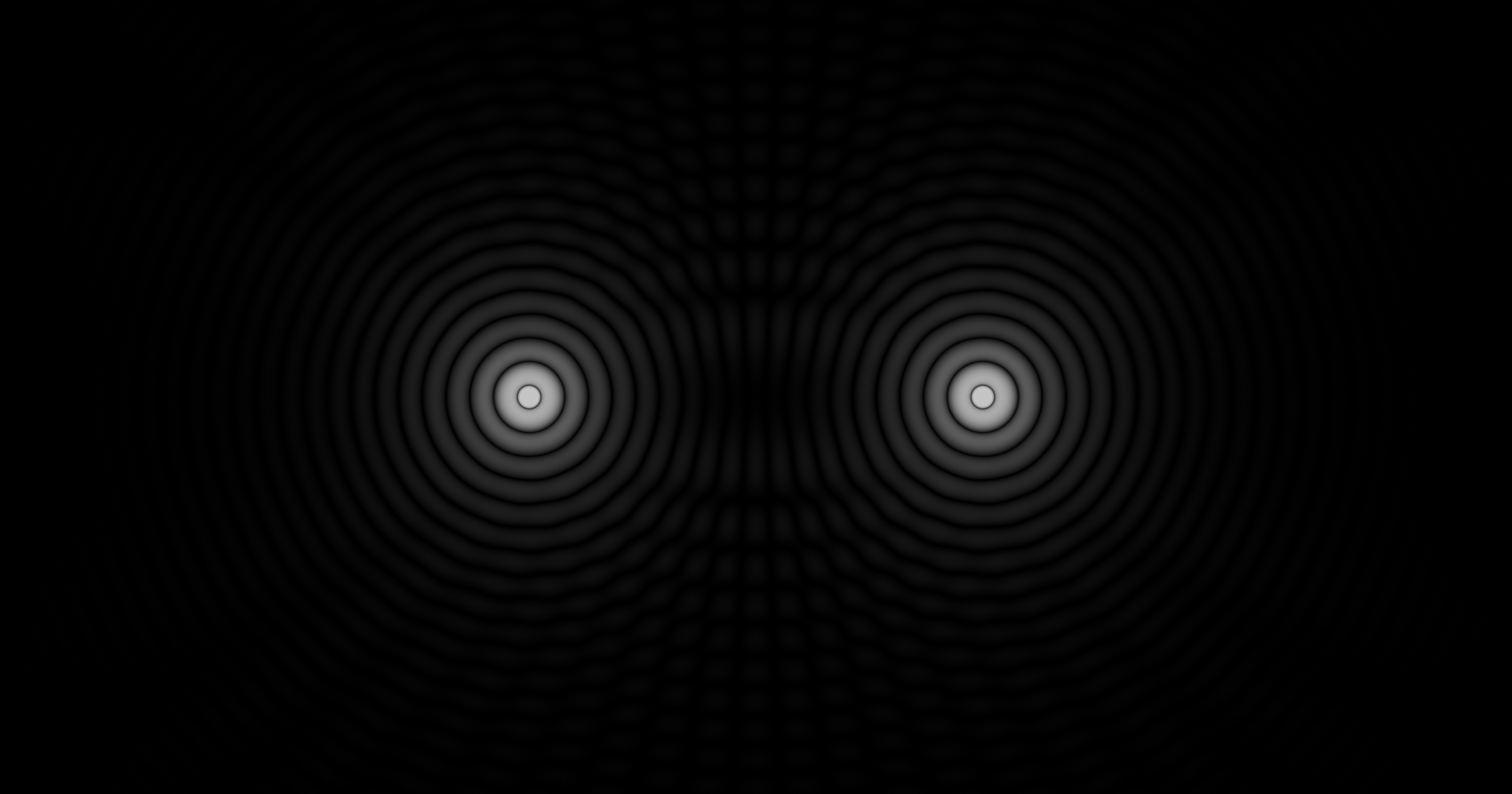
So, there are already some things we know to start building some visual representation: light propagates in waves; there is no friction or gravitation acting on it, so these waves are sine waves. If the emission point is at the center, we get this:
I hope you stared at this a bit and then tried to read this. Fun, huh?
Anyway, there is a problem with this image: the energy is the same everywhere. And if this was true, we’d receive the same radiation on Earth as if we were on the surface of the sun — we know, intuitively, this is not the case.
So, there is a decay in intensity. The culprit can’t be the field, since there is no friction or mass to reduce it, so it has to be something else. And it is quite simple: we can’t make energy out of nothing, but we can distribute it.
Back to the plucking moment: light radiates in all directions, from its origin outwards, when it is emitted. So that initial energy, as it moves away from its origin, gets distributed more and more. If it spreads in all directions at a constant speed and at the same time, then the energy is distributed through the surface of a growing sphere.
2.2 A Bit of Math (I Lied)
How do we know the intensity we have at any given distance from the origin, you ask6? We know some of the things we need:
- The energy spreads evenly, in all directions;
- If so, it is distributed on the surface of a sphere;
- The distance is the radius of such a sphere.
First, here’s the surface area of a sphere:
We can think of the intensity at any given point as the energy that was initially released (let’s call it Power) over the surface of a sphere, where the radius is our distance:
OK, now let’s find constants — values that don’t change. Here, we have two: Power and 4π. So if we combine the constant terms, we get:
Looking for constants again, we now have three: Power, 4π and 1. Only distance changes, and this is a big tell — intensity changes only when distance does, so it is inversely proportional to the square of the distance. So, just as a matter of elegance, we can take the term Power over 4π and write it as a constant k:
This is the Inverse Square Law. Basically, whenever we double the radius, the area is multiplied by four. And I’m sure you’ve dealt with this before: whenever you scale an image to double its size, its area quadruples. Half the size, a quarter of the area.
2.3 The Falloff
So, if we plot the inverse square law from the center of the image outwards, we get a map of the light’s falloff:
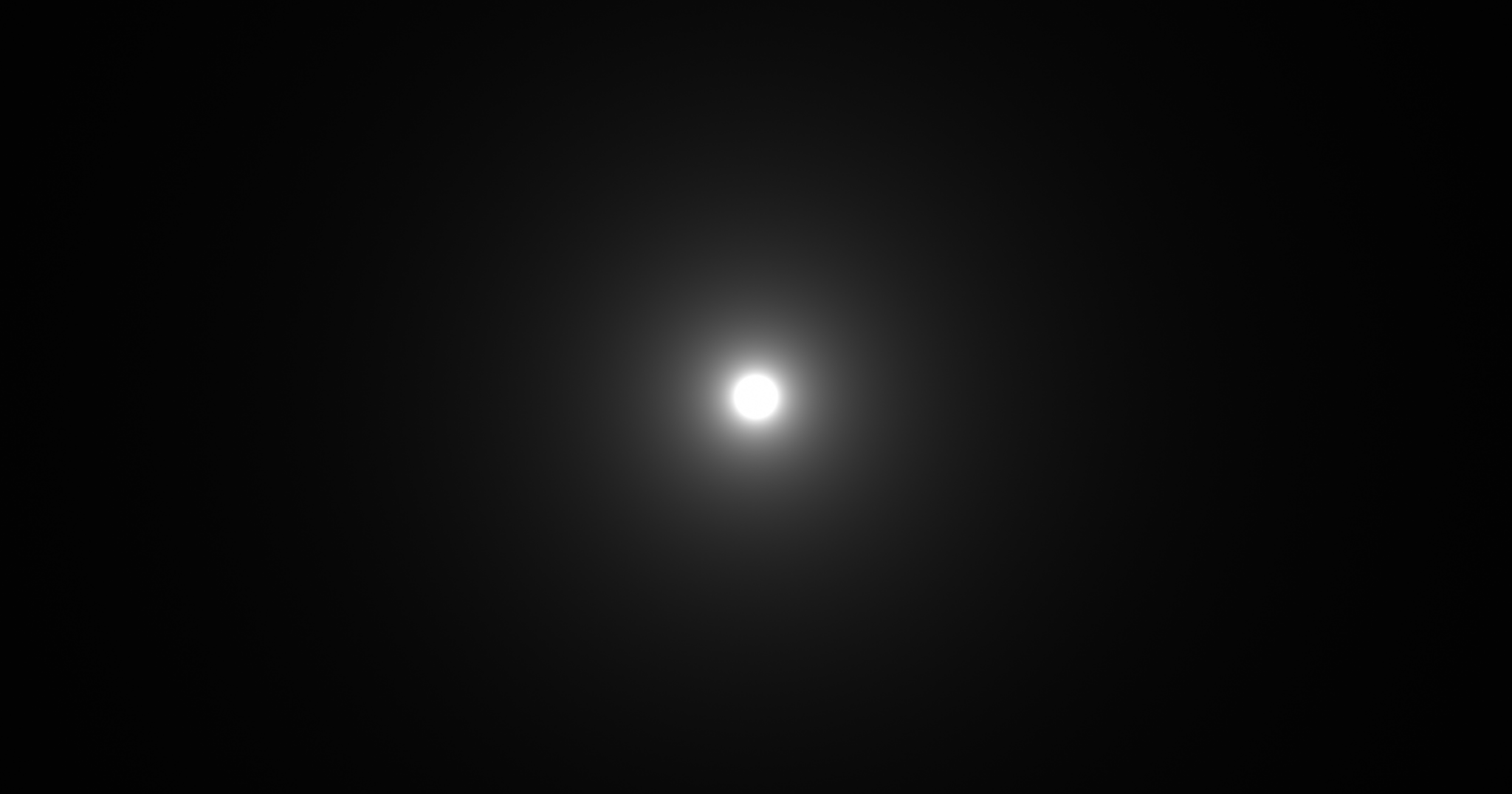
Now, it’s simply a matter of multiplying our wave with the falloff map:
Finally, one more detail: our eyes don’t distinguish between positive and negative amplitudes — what matters is if there is energy or not7. So, we can change our render to only see absolute values.
And here you have it: our first single-emitter light wave simulation!
3. Interference
It’s wonderful that you’ve survived so far, I hope it wasn’t too bad! Before we wrap this up, let’s go over another property of waves: interference.
We can think of multiple waves as being additive to the field: whenever two waves meet, their values add up. That’s where that whole negative (valleys) and positive (peaks) values matter — two waves can intensify each other locally or cancel out.
You’ve experienced this at a concert or while listening to music from external speakers: somewhere in the venue/room, the volume dims; somewhere else, some frequencies are stronger.
So why does this happen? Let’s go back to our pond. It is perfectly flat, no waves at all. And we’ll add two drippers, each at different locations. As the waves spread out, they’ll eventually meet. Here, when a high wave meets another high wave, they produce a taller wave. Where two low waves meet, they go deeper. But if a high wave meets a low wave, they flatten.
The first two cases are called constructive interference, the last one destructive. Or for sound people — since they’re usually concerned with specific frequencies — phase amplification and cancelation.
Let’s look at two waves with the same frequency and in-phase. Adding them together, we get this:
So, we doubled the amplitude — peaks and valleys are twice as big.
And if we invert the phase of one of them:
They cancel out, so we get nothing. Neat.
This always reminds me of the vuvuzela craze during the 2010 FIFA World Cup8: stadiums were so loud with all the people blasting their horns that broadcasts couldn’t directly have audible commentary. The solution? Get a vuvuzela-only track, invert the phase — effectively dimming their sound when added on top of the commentary track –, and we can now hear what people were saying.
So, football = meh; phase cancelation = yay!
Back on track: here’s an interactive example where you can slide the amplitude, phase and frequency, and see the result:
Putting it all together with our light waves, here’s a little video I made for my students:
4. Wrapping Up
This concludes this first chapter, and it is the foundation to what is to come.
I know that seems like a detour from traditional type design but, I promise, optical adjustments make much more sense when we, at least, have an intuitive grasp of light mechanics.
Also, approaching this as a physical phenomenon — because it is, the word optical in optical adjustments wasn’t a random choice — allows us to measure things. In turn, this allows us to come to better conclusions and novel ways to approach type design.
Until the next article, have a good one!
Further Reading, References
- van Blokland, E. (2014, November 8). Erik van Blokland—Optics [Video recording]. Typographische Gesellschaft München – tgm. https://www.youtube.com/watch?v=WFYTGlLeUfY
- Fenner, C. S. (1875). Vision, Its Optical Defects and the Adaptation of Spectacles: Embracing, First, Physical Optics; Second, Physiological Optics; Third, Errors of Refraction and Defects of Accommodation, or Optical Defects of the Eye. Lindsay & Blakiston.
- Fowles, G. R. (1990). Introduction to Modern Optics. Dover Publications Inc.
- Keating, M. P. (2002). Geometric, Physical, and Visual Optics (2nd edn). Elsevier Health Sciences.
- Inverse-square law, Wikipedia.
- I’m using sinusoid and sine interchangeably here. We could have plotted a cosine wave to achieve the same effect — both sine and cosine waves are sinusoids. ↩︎
- God, that Feng Shui man lives in my head rent-free. ↩︎
- I always imagine electrons going woo-hoo! ↩︎
- As in things made of atoms. ↩︎
- Electrons have an electric charge, hence the name. The “plucking” is this charge interacting with the electromagnetic field by, again, its sudden change in orbit. ↩︎
- Wisely, I should say. ↩︎
- We’ll go through the eye anatomy in a later article. I’ll edit this note when it is available. ↩︎
- To prevent people from talking to me about football, I’m probably one of the most ignorant people out there when it comes to it. I really don’t care, I don’t see the point, nor am I interested in finding it out. So let’s not bore each other to death. ↩︎